

Meon Valley MP visits Butser Ancient Farm
Meon Valley MP Flick Drummond visited Butser Ancient Farm recently for a tour of our ancient buildings and landscape, alongside a discussion of the current challenges and opportunities we’re facing.
It has been wonderful to reopen Butser to visitors over the summer and start to get back on our feet after such a difficult few months. A huge thank you to everyone who has supported us!
We are currently working on funding applications and plans to help us over the winter months and recently had the pleasure of welcoming local MP Flick Drummond to the farm to discuss challenges and opportunities for support from the government. Find out more below.
Meon Valley MP Flick Drummond visited Butser Ancient Farm recently for a tour of our ancient buildings and landscape, alongside a discussion of the current challenges and opportunities faced at our unique heritage site in the South Downs National Park in East Hampshire.

MP Flick Drummond Meets with Butser Ancient Farm Directors Simon Jay and Maureen Page in front of the ongoing Horton House Stone Age construction.
The Farm, which reopened to pre-booked visitors on July 4th and has 'We're Good to Go' accreditation from Visit England, was a hive of activity on a beautiful summer's day, with visitors meeting the new baby goats, watching thatching and ancient skills demonstrations, and exploring the reconstructed ancient homes and buildings. However, after coming out of three months of lockdown, with a subsequent total loss of income during what would have been our busiest time of the year, we are facing a challenging time ahead.
With the recent announcement that the new Culture Recovery Fund for Heritage is now open for applications, the visit was a fantastic opportunity for Flick to discuss the government's support package for the struggling arts and heritage sector.
Farm directors Maureen Page and Simon Jay were able to highlight their concerns and hopes for the future as Flick offered her support to any application the farm makes to the Recovery Fund.
Director Maureen Page said 'As Butser approaches it's 50th year of opening it has been very difficult for us to close for such a long period of time. We love to welcome visitors to explore the ancient past with us and usually host hundreds of school children each week to be inspired about ancient life. This in turn helps to fund our ongoing archaeological research work, enabling us to build and experiment with exciting new interpretations of ancient life, and continue our community wellbeing and volunteering programmes. We are anxious to continue this important work and need all the support we can get in order to do so'

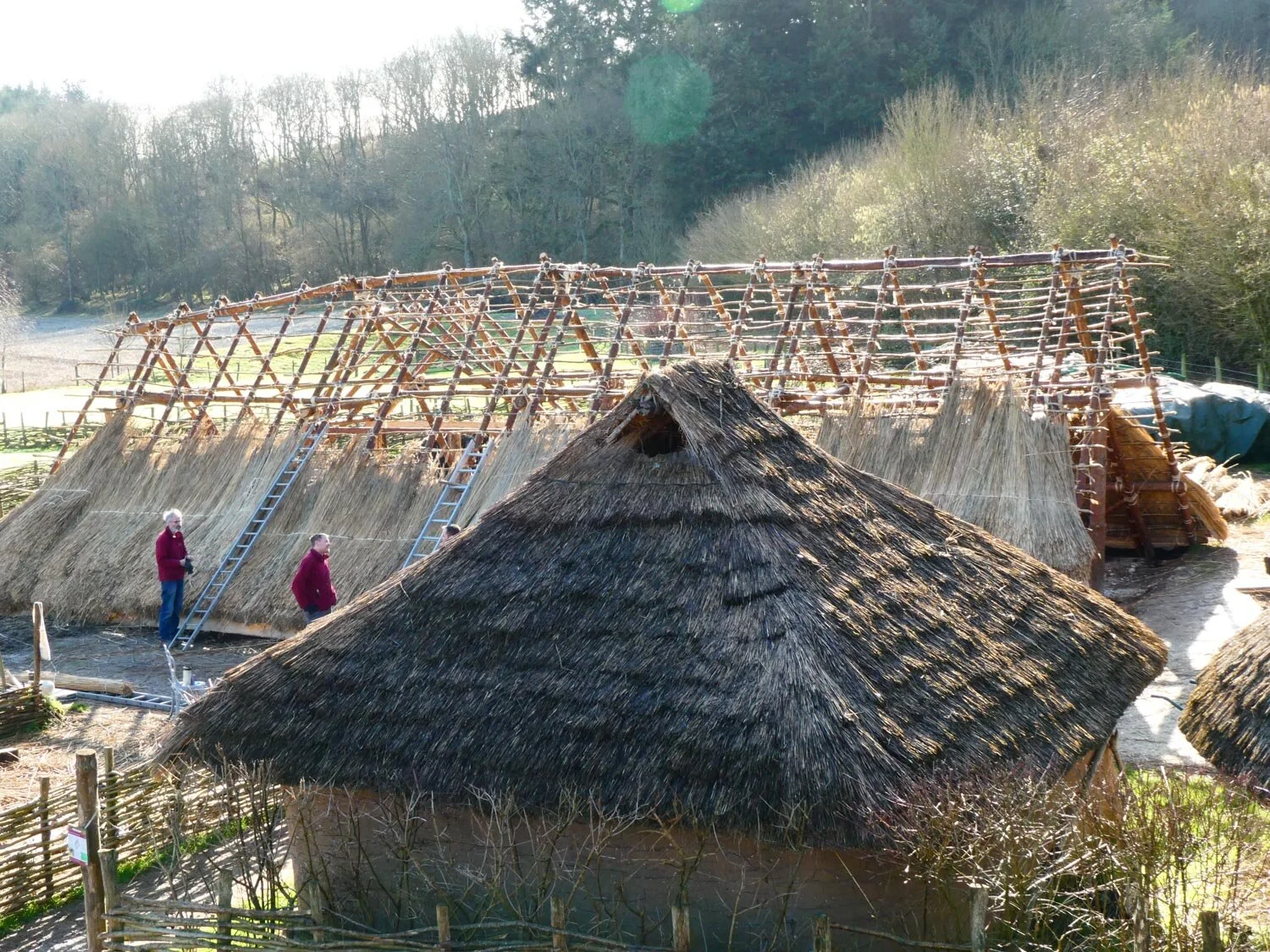
Butser Ancient Farm Director Simon Jay and Master Thatcher Lyle Morgans talk to MP Flick Drummond about the thatching of the Moel Y Gerddi Iron Age Roundhouse.

MP Flick Drummond with Butser Ancient Farm directors Maureen Page and Simon Jay as the Moel Y Gerddi Iron Age Roundhouse is thatched by master Thatcher Lyle Morgans in the background.
Butser Ancient Farm usually welcomes over 35,000 school children to the Farm every year for a hands-on experience of ancient life. School children take part in a range of practical activities within the reconstructed buildings, representative of homes from the Stone Age, Iron Age, Roman and Saxon periods.
Although school trips are permitted to resume from September, there is still uncertainty over coach travel and the way in which schools will be able to travel to locations such as Butser Ancient Farm. With many attractions and educational centres facing similar issues, and coach travel companies also struggling, the visit was a valuable opportunity to raise these concerns. Flick will be able to represent and highlight these issues in ongoing government discussions.
With experience on the board of governors for a local School, Flick's interest in education and practical learning was a great match for Butser Ancient Farm, who pride ourselves on an inclusive, hands-on approach to education and learning. Indeed Flick was able to see and discover Bronze Casting in action, traditional thatching techniques in use and rare-breed goats being milked, all during her tour of the farm...all in a day's work at the farm!
As an independently funded, not-for-profit organisation, Butser Ancient farm relies on visitor income and donations to support our work. If you would like to visit and support us over the Summer we are currently open from Wednesday to Sunday for pre-booked visitors. Find out more and book tickets here.
What do we all have in common with Henry VIII?
Sadly we are currently unable to continue with our Stone Age House build as a result of the site closure and government restrictions related to COVID-19. Instead for this weeks blog our Archaeologist Claire has turned her attentions to the historical and archaeological precedents of the extra-ordinary times we are living through…
Sadly we are currently unable to continue with our Stone Age House build as a result of the site closure and government restrictions related to COVID-19. Instead for this weeks blog our Archaeologist Claire has turned her attentions to the historical and archaeological precedents of the extra-ordinary times we are living through. We hope you are all staying safe and well in these difficult times.
What do we all have in common with Henry VIII?
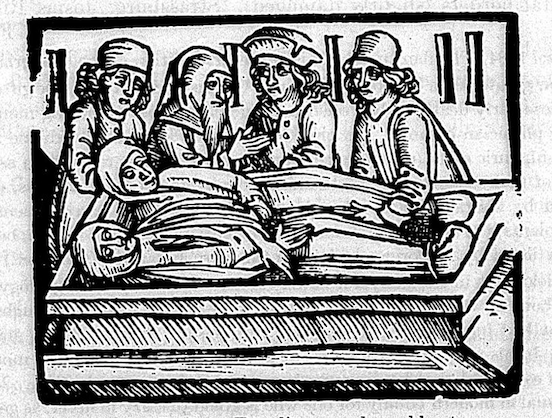
Not festering leg ulcers, constipation or malaria (hopefully)…..By the quirks of fate and mother nature, we find ourselves in the shoes of Henry and his country folk in contemplating life during an epidemic. Apparently Henry was so afraid of contracting what was called the ‘sweating sickness’ that he would isolate himself in his rooms, and when travelling around the country, would send his men before him to establish that towns were free of this mysterious and highly infectious disease. I can’t say I blame him. However, I also read somewhere that he had the sick thrown out of their houses in Windsor and Calais and left them to die in the fields. Not exactly champion of the people then.

Henry VIII by Hans Holbein the Younger
Until recently, there was very little in the way of treatment for most infectious diseases. Therefore people lived in fear. Sometimes people did act by social distancing, which was surprisingly logical, considering their very poor understanding of how such diseases were spread. The word quarantine stems from the Venetian’s practice of isolating travellers from ships on islands in the lagoon for, in Italian, ‘quarantino’: 40 days, to ensure they were free of plague. No less logically, but completely pointlessly, they also armed themselves with nosegays or ‘tussie-mussies’ - a small bunch of sweet smelling flowers into which you’d bury your nose, hopefully warding off the evil miasma of disease or plague. (If you fancy going a bit historical you can make your own by following this link: https://www.yac-uk.org/activity/make-a-tussy-mussy)
There have been many epidemics in human history aside from the sweating sickness that struck fear into the Tudors. Typhoid fever which struck Athens during the Peloponnesian war against Sparta, the Antonine Plague in 160 AD, to which the Emperor Marcus Aurelius is thought to have succumbed and the Black Death of 1350 to name but a few. This list goes on. In other words, COVID -19 is just one of many, many epidemics which we humans have encountered.

Portrait of Emperor Marcus Aurelius. Roman artwork of the Antonine period.
It has been suggested that most infectious diseases in humans stem from contact with animals. And the more dense the human population, the more likely we are to come into contact with animals harbouring these diseases. Leprosy, anthrax, cow pox, rabies, plague and various contagious fevers. They all jumped from animals to humans. We call diseases like these ‘zoonoses’ from the Greek zoon (animals) and nosos (sickness).
When such diseases spread to humans, there is always the small risk that if they are viral, they will mutate into a form which can be passed directly from human to human, no longer requiring the animal agent. This is what has happened with coronavirus.
But this isn’t just a result of a modern, globalised society. The transfer of infectious diseases between animals and humans goes back at least as far as the Neolithic. For example, the domestication of cattle, pigs, goats and sheep was probably where humans acquired a disease called brucellosis, caught through contact with their urine, blood or poo, and preparation of their meat for cooking. Although this one is a bacterial infection, the symptoms are kind of similar to flu (which is viral) but chronic. Rubbish if you caught it (until antibiotics were invented there was no treatment) but interesting for us as archaeologists because the effects of brucellosis can be seen in the human skeleton as bone lesions.

The current pandemic offers us a rather unwelcome window on historical plagues, something we’ve probably all pondered over with gruesome fascination at some point before it all got a bit too darn real. Now we’d rather forget about it. But here’s why we shouldn’t.
Never has the study of history and archaeology been so relevant. Knowing that we share this experience with others offers solace. Understanding that this time of fear and uncertainty will be over, just as with all other pandemics before, offers a tiny shred of consolation when it feels like 5 days shut in your house is forever. Stay strong and be kind (unlike Henry VIII).
Neolithic House Project week 12
This week our Archaeologist Claire talks about the porch design and construction of our Horton House.
This week our Archaeologist Claire talks about the porch design and construction of our Horton House.
In these strange times, there is only one thing I imagine most of us have been talking about, and quite understandably. Despite this and maybe indeed because of this, we at Butser have dedicated some time over the last few days to working on the porch of our Neolithic house. Doing a practical activity requires focusing on the task in hand to the exclusion of all the other jumbled up thoughts in our brains. A little bit of mindfulness in the midst of psychological chaos, you might say.
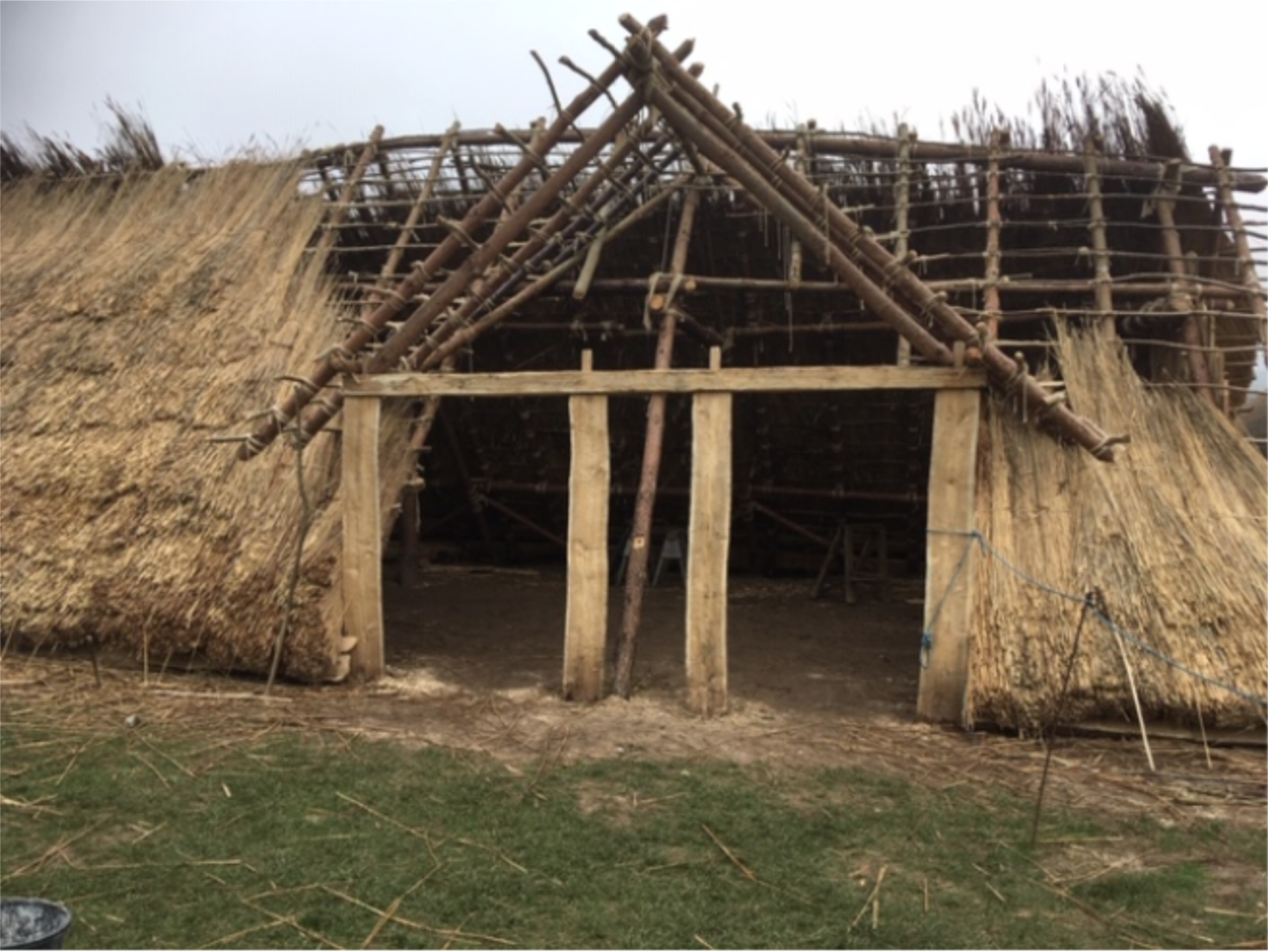
In experimental archaeology, it is really important to reflect every aspect of the original archaeology as accurately as possible, including the direction in which the house faced. Over time, this will enable us to measure weather related wear and tear, and gain further insight into Neolithic building skills and knowledge. In the case of the Horton house construct at Butser, this means a doorway on the far side of the building, hidden from view and not immediately obvious to visitors.
So, it would be useful to have a porch that visually defined where the entrance to the house is. But this was not our only consideration. It was also critical that the entrance provided unhindered access to the building for all our visitors, including those with mobility and disability issues. Fortunately, no compromise of the real archaeological evidence was required in order to achieve this.
Thirdly, and equally importantly our porch has to be a feasible interpretation based on the evidence. There could have been a number of interpretations, and in fact there are at least two in existence.
Compare the actual build here on site:
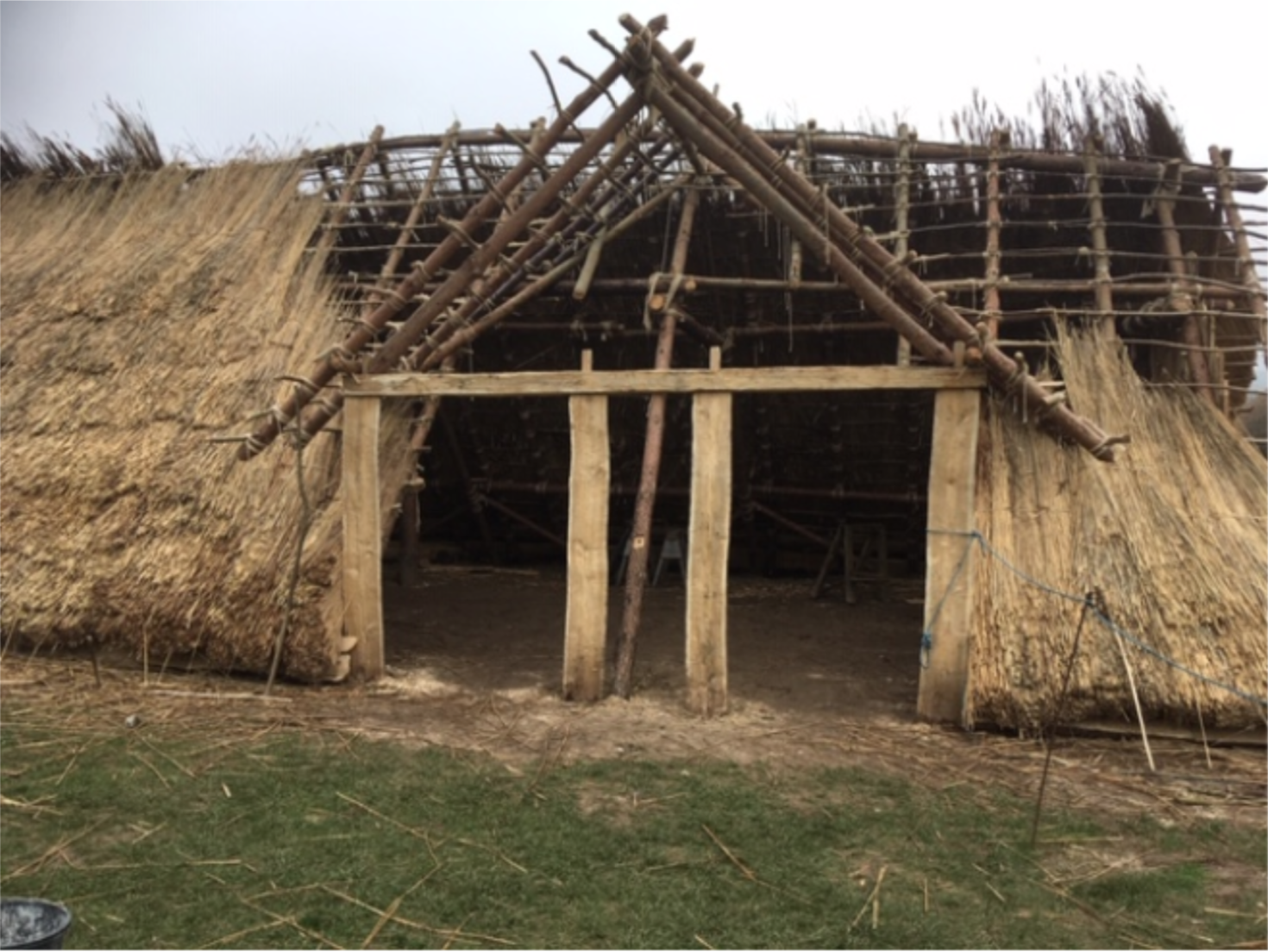
With the scale model constructed by Andy from Wessex Archaeology: (note how that Playmobil archaeologist from a few weeks ago is the perfect scale for this house!)
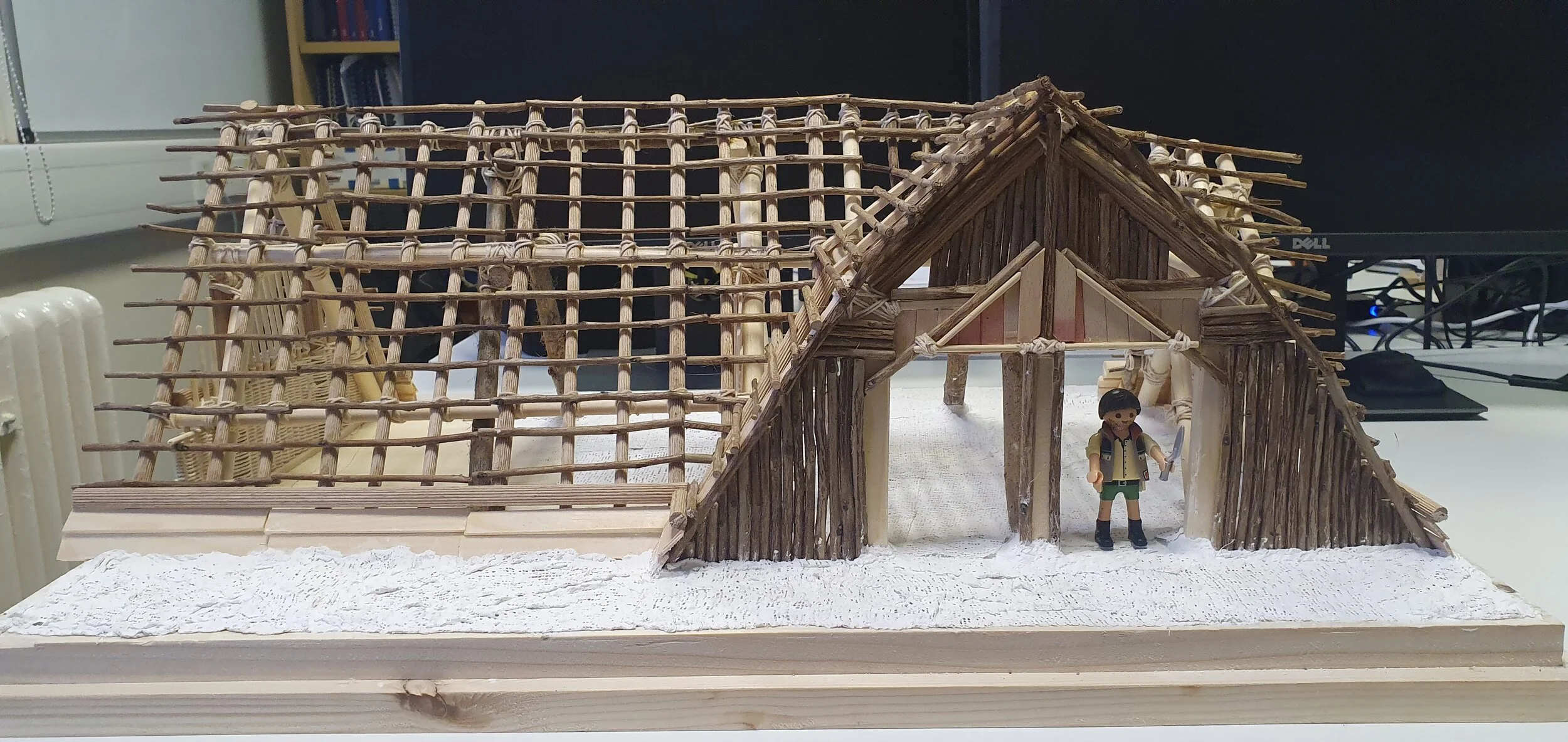
Note how Andy’s model has a porch the rafters of which run to the ground, with vertical planking on the front face, while our rafters stop far short of the ground. We loved Andy’s idea but our thatching schedule was such that we had already thatched round the porch, making Andy’s design too tricky to create! The important point here is that both are equally valid concepts. This is why we should always think of experimental archaeology as a means of understanding what COULD have happened in the past, and not a way of categorically defining what DID happen.


Neolithic House Project week 11
This week on our Neolithic house project we have moved on to the wonderful task of daubing. Here Southampton University Student Mackenzie explains more…
This week we have a guest blog post from Mackenzie who has been helping with our Stone Age house project as part of a student placement from Southampton University. We’ve now moved on to daubing our wattle wall and Mackenzie shares a bit more about this process below…

Hello! I am Mackenzie, I am a Masters’s student at the University of Southampton specialising in Osteoarchaeology. My personal interests in archaeology pertain to the investigation of animal (zooarchaeology) and human remains (osteoarchaeology) from the past. I am very interested in the assessment of disease pathology as well as burial practices and how these themes inform archaeologists today of past cultural behaviours. I completed my undergraduate degree in Anthropology at Portland State University in the USA and have participated in mortuary excavations in Poland at a medieval village site (see image above).
Any who, enough about me…
Let’s get dirty! Last week the Wessex team completed wattling the west wall of the house and now it is time for the team to get down and dirty with some daub! In preparation for the Wessex team, Archaeologist Claire, work placement student Christian, and myself reconstituted the daub that was used on the previous Neolithic house. Just like a pre-made pancake mix, all we did to reconstitute the old daub was just add water! Because Butser is all about recreating the past experience, we did not simply use a spade to stir together our daub and water… nope, nope, nope we tried using a cow scapula!

Mackenzie using a cow scapula to stir daub!
I should note, in the past the scapula would have been hafted onto some sort of wooden handle, but our idea to try it out was very last minute and we did not have time to create a haft so we improvised as one often does in archaeology. Once we concluded that the Scapula method was indeed feasible, we did revert back to our modern tools of spades and feet- I think Claire had a bit too much of a good time stomping around in her wellies, we all know how she feels about cow poo after her last few blog posts!
On a more desk-based note, I have been holed up in Heartly Library at the University of Southampton trying to read up as much as I can on the houses of the Neolithic (see references below). I have found this much more interesting than expected, particularly combined with my personal experience of the build, and many revelations have come to pass… the biggest one of all being… Neolithic people were just like us!
As archaeologists, and non-archaeologists, we tend to separate ourselves from people of the past. We always talk about how much more “advanced” we are today. In reality, when it all boils down, we are the same. This house construction project has proven that we use the same tools, such as axes and chisels. We use the same materials, the division of labour is likely to be very similar, and the activities done both in and outside of the house would have likely been similar to how we use our spaces today.
My research has shown me that in the British Isles many Neolithic houses were rectangular ranging in sizes up to 242m2, these houses typically had an entrance on the North-West wall, 2-3 rooms or cells and possibly lofts for grain storage. All these features are demonstrated in our reconstruction!

My time here at Butser has been invaluable through these experiences I have felt a deeper connection with our Neolithic Ancestors and a greater realisation of the continuity of cultural traditions overtime. Everyday at the farm is a day full of fun and I am continually astonished by the possibilities for new discovery presented in archaeology. There is always something to be learned, a source of inspiration and some way to get dirty!
References
Werra, D., 2010. Longhouses and long-distance contacts in the Linearbandkeramik communities on the north-east border of the oecumene: “à parois doubles in Chełmno Land (Poland). In Anthropologica et Præhistorica, 121. Pp. 121-142.
Smyth, J., 2006. The Role of the house in early Neolithic Ireland. In European Journal o. f Archaeology, 9(2-3). Pp. 229-257.
Pyzel, J., 2012. “Chapter 8: Change and Continuity in the Danubian Longhouses of Lowland Poland”. In Hoffmann and Smyth (eds.) Tracking the Neolithic House in Europe. Springer, New York.
Fairweather, A. and Ralston, I., 1993. The Neolithic timber hall at Balbridie Grampian Region, Scotland: the building, the date, the plant macrofossils. Antiquity, 67. Pp. 313-323.
Darvill, T. and Thomas, J., 2002. Neolithic houses in northwest Europe and beyond (Vol. 1). Oxbow Books.


Neolithic House Project week 10
Week 10 of our Horton House Neolithic project and the thatching, wattling and planking continues. Trevor Creighton reflects on the different building techniques we’re testing and the huge communal effort involved in the build so far.
This week our projects co-ordinator Trevor Creighton has been reflecting on the many people who have been involved in our Horton House build so far , and the different building techniques we are using in the construction.
We’ve been recording the progress of the Horton Neolithic house build using time lapse photography. We have a bit of a laugh in the office watching the superfast action, with little figures rushing in and out of frame carrying thatch, tools, and mugs of tea, and the occasional visitor’s face popping – knowingly or otherwise – into frame. If you remember the Benny Hill Show you’ll get the picture.
But the most striking aspect of watching these cinematic rushes is seeing how many different people have been working on the project. Claire has mentioned the fantastic efforts of the Wessex Archaeology crew in former posts. Their wattling is the stuff of legend – so much so that the western end of the building has been dubbed the ‘Wessex Wall’. We also have fantastic work being done by some of Butser’s regular volunteer team. They have been constructing the eastern wall using vertical planks set into the ground at the base, rising almost to the top of the building (we are leaving a small, triangular opening at the top for smoke to escape) and secured with wooden pegs. This labour of love is called the ... wait for it... ‘Volunteer Wall’. Poets and archaeologists are close bedfellows.


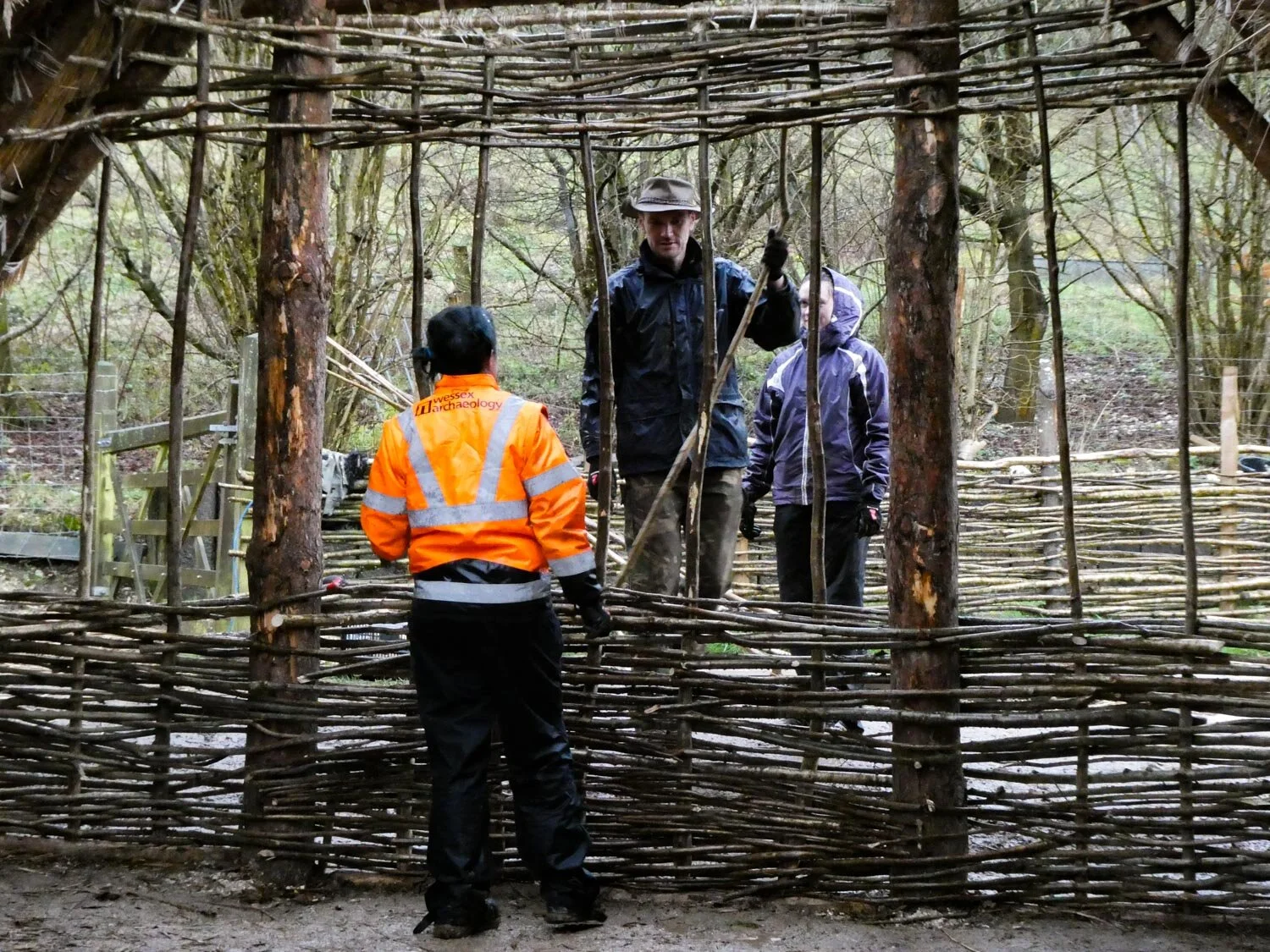

The different types of wall are significant not only as great projects for the people involved, but also as aids to understand the building – both for visitors and for archaeologists. It is impossible to tell from the archaeology exactly how the walls on the original building were constructed. In building different variations – wattled walls at one end, planks at the other, and horizontal timbers on each side – we have two important aims. One is to demonstrate to visitors that experimental archaeology involves a lot of supposition (OK, informed guesses if you will). By offering three possibilities for the wall construction this process is clear for all to see – we are keen to avoid any suggestion that we are ‘rebuilding’ a known past. The other important aspect of this approach is that when the building is ultimately demolished, the footprint from each different wall interpretation might well give us some clues as to how the original was made! Let’s hope that’s a way off, though!

Neolithic House Project week 9
Week 9 of our Neolithic House project and we’ve been working on our wattling skills!
Week 9 of our Neolithic House project and we’ve been working on the wattle wall on one end of the house with the help of a team from Wessex Archaeology. Here our Archaeologist Claire reflects on the importance and nature of wattling!
We all have weird archaeological obsessions, and those who know me here will tell you mine is toilets and poo. To frame that in academic (and more palatable terms) that’s waste management and disposal in the past. So you can imagine my excitement when I get the opportunity to write about it under the guise of discussing building construction!
Re-creating buildings from the past is often an opportunity to gain a better appreciation of the materials and their qualities. This is certainly the case with wattle and daub which we use extensively here. Wattle being the woven structure onto which a malleable filler made partially of cow poo is pushed, forced or pressed.

It is one of the mainstays when it comes to traditional building materials, and has been since the Neolithic. We have evidence from many parts of the world, including Çatalhöyük in Turkey, commonly thought of as one of the world’s first large scale settlements. Variations on the same theme are mud and stud, jacal, bajarreque, pierrotage and columbage. Its modern equivalent is lathe and plaster.
In Britain, the wattle frame has traditionally been made of quick growing coppiced woods like hazel and willow, woven around vertical staves made of hazel, oak, ash or similar.

The construction of the buildings here at Butser lend themselves to the more simple square panels, where the wattle is woven horizontally through long runs of open panel work, but during later historical periods building techniques created much smaller spaces between structural timbers, and therefore other techniques such as close-studding were utilised. I’d very much recommend Trevor Yorke’s delightful pocket sized ‘Timber-Framed Building Explained’ for those of you interested to find out more about such matters.
Daub used to cover this frame essentially needs to consist of three things: a binder like clay, lime and chalk dust, an aggregate for bulk like soil or sand, and a reinforcement such as straw or hair. Animal poo, usually cow manure is a tried and tested ingredient – it’s sticky, stretchy and made up of organic, fibrous material. Mixed together by humans’ feet or trampled by livestock, these materials are glued by forcing it onto the wattle frame, left to dry and then often painted with clay or limewash. Fascinatingly, daub is one way of ascertaining through the archaeological record, that building homes was a family affair. Archaeologists can ascertain from examining lumps of excavated daub that there are cases where the balls were clearly formed by child sized hands.
While you can’t tell whether grandma or grandchild stuck this example onto a building, you can clearly see the impression of the wattle in this excavated example. (thank you Maisie from Pre Construct Archaeology, for this sample).

On a final note, I’d like to return to the subject of books that have inspired me in the process of thinking about building techniques in the past. Originally published in the early seventies ‘Shelter’ by Lloyd Kahn is a beautifully illustrated and annotated book paying homage to building construction across space and time. Heart warmingly, at the core of this book is an acknowledgement that what drives humans to create structures for living goes further than just the need for shelter; it is the desire in all of us to have a place we can call home.
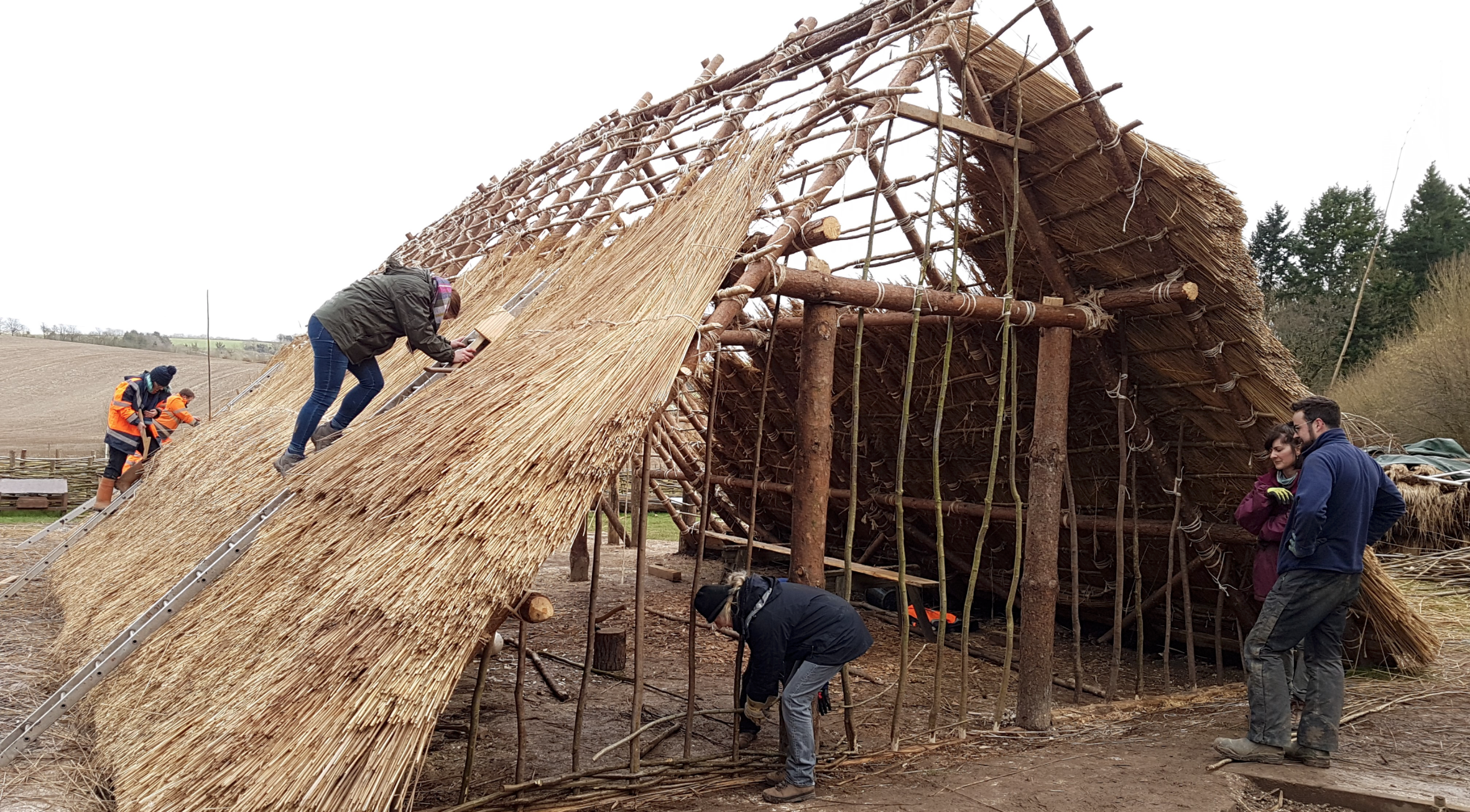
Here are some pictures of the team from Wessex who joined us this week to help with our wattle wall!


Neolithic House Project week 8
Week 8 of our Stone Age house project and we’ve been welcoming staff from Wessex Archaeology to help with wattling and coppicing.
Week 8 and we are busy thatching, wattling and coppicing as well as talking to lots of lovely visitors about the build as part of our February half term activities. We were also joined by some of the team from Wessex Archaeology for a day helping us with our wattle wall, affectionately named the ‘Wessex wall’!
Here our archaeologist Claire shares a bit more about our progress this week…
Yesterday we were joined by Phil, Holly, Finn, Karen, Jenny, Robyn and Emma from Wessex Archaeology. It was great to have people from a wide number of departments, particularly office staff who don’t normally get to feel the wind and rain in their face during daylight hours!
Because I didn’t have the wherewithal to take a group photo, I have substituted it with a scenic shot of a ‘typical’ archaeologist (according to Playmobil anyway). Actually I thought they got it pretty spot on:
Dishevelled and unwashed, with clothes that could stand up on their own: Check!
Hasn’t bothered to shave for a few days: Check!
Hangover from hell: Check!

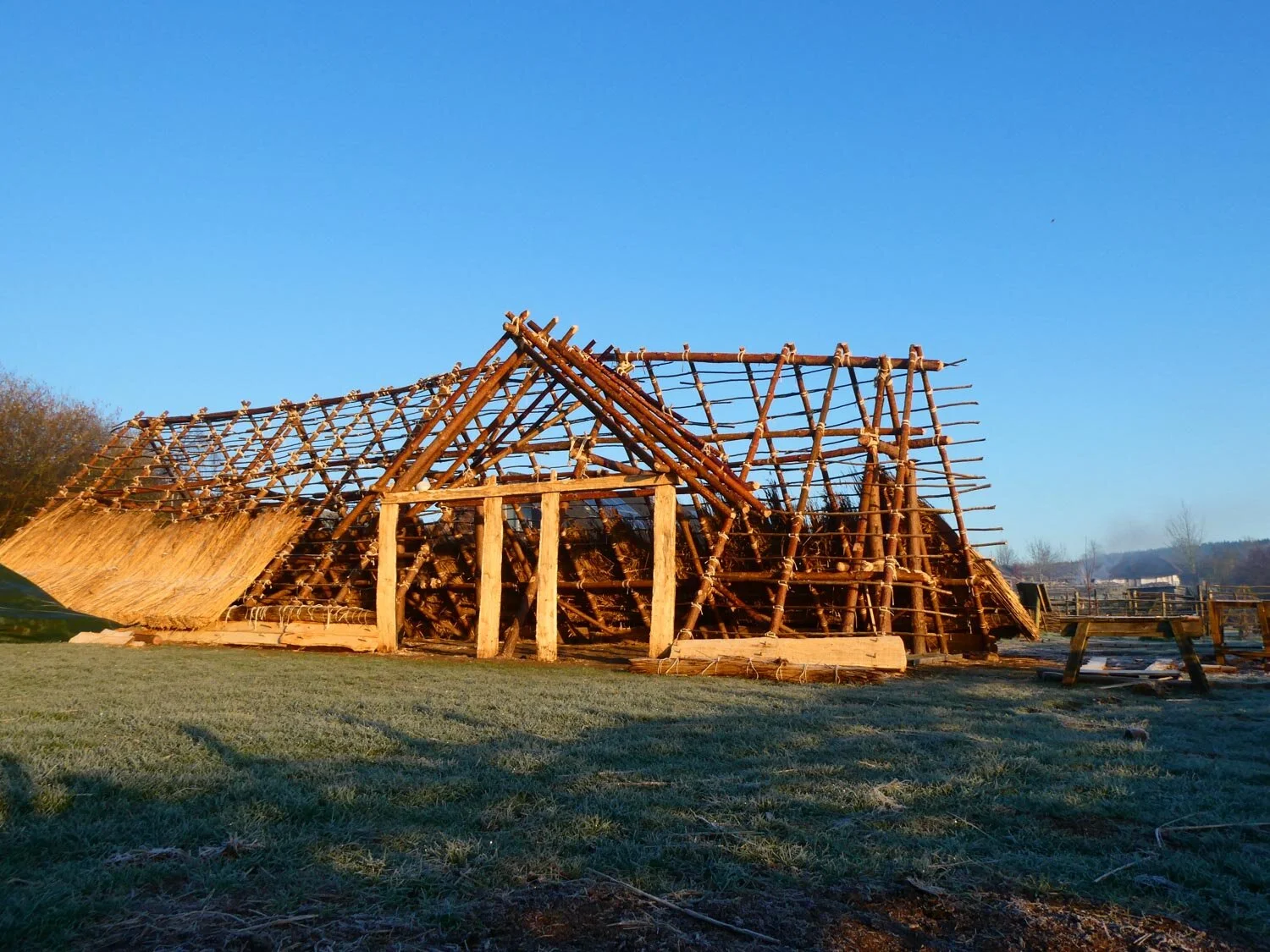
Clearly modelled on a number of digs I have had the pleasure to be on but of course nothing like the professionals at Wessex. Out respectable, clean, sober and enthusiastic visitors were given a short introductory tour of the farm, followed by an opportunity to inspect the house under construction. In addition to trying out some thatching, our helpers are joining us to help construct one of the end walls of our house.
At the wider end, we have chosen to build with wattle and daub. Our Wessex team divided into two groups. The first focused on stripping all the side shoots from hazel which we had cut down in our own little coppice here on site. This hazel will form the long rods which we wattle with. This was an exciting opportunity to be let loose with billhooks, and everyone enjoyed using hand tools, particularly Emma who normally wields a pen in the office. She proudly showed me the blister she had gained from all her efforts!

The second team worked on preparing the upright ‘staves’ around which we will weave our wattle wall. There was some good humoured confusion and discussion about exactly how to get started with the wattle – it’s a bit of a challenge when it’s all being done under the eaves of a building as we are here. But, that is the nature of experimental building – testing out ideas and then adapting them as you go along. Hopefully by the time the second group of Wessex volunteers join us next Tuesday, we will be well on our way with the wattling. Probably best not tell the last group that all that will be left to do when they get here in a couple of weeks is the daubing (that’s sticking cow poo on the walls to you and me……)


Neolithic House Project week 7
Week 7 and we’ve been doing some calculations and reflecting on the huge team effort and resource requirements of building a Stone Age house like this!
Week 7 of our house project and Archaeologist Claire reflects on the team effort and resources that have so far gone into building our house.
Calculations and collaborations
Like a scene from DIY SOS, the house had people swarming all over it yesterday, beavering away at various tasks, from thatching to attaching oak planking, tidying loose cordage, levelling the floor, and digging trenches for a sill plate to sit in. The weather was glorious, spirits were high and the feel good factor was evident. It’s the closest I’ve felt in terms of communality, to what a build might have been like in the Neolithic.
Throughout the construction, we have kept track of the amount of materials used. These calculations allow us to extrapolate how many ‘(wo)man’ hours it might have taken, and how much time within a community would have been dedicated to each task. Everyone from school age to the most hardened academic enjoys the thrill of knowing how many tons of thatch there are on the roof directly above their head. Current calculations for the amount of thatch round out at about 6.12 tonnes!
We’ve also worked out that we’ve used to date, 1440 metres of cordage for thatching, 2728 metres for lashing the battens on to the rafters of the roof and another 864 metres of heavier duty rope for the major structural joints.
In terms of the timber used, our calculations suggest we’ve used in the region of 6.6 tonnes of Scot’s pine just to form the main structure, plus around 570kg of hazel for the battens.
Finally for this week, I should mention that we have a few special days lined up with Wessex Archaeology.
Wessex have already been extremely generous with their time and expertise, joining us for events and allowing us access to their amazing array of skilled staff, from drone pilots to graphic designers. The directors at Wessex have generously agreed to allow 20 of their staff, from office staff to hardened diggers to join us across 4 ‘health and wellbeing’ days. Such activities offer opportunities for learning, skill sharing and networking, as well as being good for mental and physical health, particularly for those who many not otherwise work out of doors, or carrying out manual, hands-on tasks. We’re really looking forward to welcoming the teams to the farm to join us on the build in the weeks ahead!








Blog archive
- December 2025 1
- November 2025 2
- September 2025 1
- April 2025 2
- February 2025 1
- January 2025 1
- November 2024 2
- August 2024 1
- July 2024 2
- May 2024 1
- November 2023 1
- October 2023 1
- September 2023 1
- August 2023 1
- July 2023 1
- June 2023 2
- May 2023 2
- March 2023 1
- February 2023 1
- December 2022 1
- October 2022 1
- August 2022 2
- April 2022 1
- March 2022 2
- February 2022 1
- January 2022 1
- December 2021 2
- November 2021 3
- October 2021 2
- September 2021 5
- August 2021 2
- July 2021 3
- June 2021 3
- May 2021 2
- April 2021 4
- March 2021 1
- November 2020 1
- October 2020 2
- August 2020 1
- March 2020 4
- February 2020 4
- January 2020 3
- December 2019 3
- November 2019 1
- October 2019 1
- September 2019 1
- August 2019 1
- July 2019 6
- June 2019 3
- April 2019 2
- March 2019 3
- February 2019 2
- January 2019 1
- November 2018 1
- October 2018 2
- September 2018 3
- August 2018 4
- July 2018 2
- June 2018 2
- May 2018 2
- March 2018 6
- February 2018 1
- October 2017 1
- September 2017 5
- August 2017 4
- July 2017 3
- June 2017 1
- May 2017 1
- April 2017 3
- March 2017 2
- February 2017 3
- January 2017 1
- December 2016 2
- November 2016 1
- September 2016 1
- August 2016 2
- July 2016 2
- June 2016 3
- May 2016 2
- April 2016 1
- March 2016 2
- February 2016 1
- January 2016 3
- December 2015 2
- November 2015 1
- October 2015 1
- September 2015 2
- August 2015 1
- July 2015 2
- June 2015 2
- May 2015 3